The Ciutat de les Arts i les Ciències one of the most important landmarks in València. And the good news is that most people don’t ended to spend anything to visit it. So in this guide, I’ll be going over what to see in the City of Arts and Sciences, and, more importantly, what’s actually worth spending your money on.
If you have any questions or want me to help you plan your itinerary for you, then reach out here.
- The Prices & Is It Worth It?
- Quick Details about La Ciutat de les Arts i les Ciències
- What Is the Ciutat de les Arts i les Ciències?
- How to Get to the Ciutat de les Arts i les Ciències
- How to Buy Tickets
- The Buildings in La Ciutat de les Arts i les Ciències
- The Trencadís, and Why Everything Is White
- The Best Photo Spots
- Visit in the evening
- Which Single Building Should You Pick?
- What It Cost, and Why Some Valencians Resent It
- The Free Version
- Planning Your Trip to Valencia?
- Bon viatge,
- FAQs
- Want no-stress travel planning?
- Need help planning your trip to Valencia?
The Prices & Is It Worth It?
A combined ticket for the three main ones runs €51.25 for an adult in 2026, and covering all three properly takes six to seven hours. Most visitors need far less than that.
That is the short answer. The longer one is that this complex is six buildings, two bridges and a lot of water spread over roughly 350,000 square meters, and the difference between a good visit and an expensive, exhausting one comes down to about four decisions you make before you arrive.
I have lived in València since 2018 and I have walked visitors through this place more times than I can count. The pattern is remarkably consistent: people come for the architecture, get talked into a combined ticket at the window, and spend the afternoon in a science museum they did not particularly care about…
So I would say: if you’re coming with children OR you’re a big nerd (I say this lovingly), then you should pay to go inside. If you just want a selfie or to see the architecture, don’t bother paying.
Quick Details about La Ciutat de les Arts i les Ciències
- Where: the southeastern end of the Jardins del Túria, about 3 km from the old town
- Free to enter: the whole outdoor site, the Umbracle, both bridges, the Hemisfèric’s perimeter ring
- Paid buildings: Oceanogràfic, Museu de les Ciències, Hemisfèric, and CaixaForum in the Àgora
- Combined ticket (three CAC buildings): €51.25 adult, €40.40 child 4 to 12, over-65s and visitors with a disability
- Valid for: one, two or three consecutive days
- Nearest stop: Metrovalencia line 10, Ciutat Arts i Ciències-Justícia or Oceanogràfic
- Time needed: 90 minutes for the exteriors, six to seven hours for all three paid buildings
- Best time to arrive: 10:00 for tickets, or late afternoon for photographs
What Is the Ciutat de les Arts i les Ciències?
The Ciutat de les Arts i les Ciències is a cultural and scientific complex at the southeastern end of the Jardins del Túria. It was designed mainly by the Valencian architect Santiago Calatrava.
Today, it’s undoubtedly one of the most famous things to see in Valencia. However, not all Valencians love it. In fact, there was a LOT of pushback against it, mostly due to the misappropriation of funds and corruption around its building.
I have a full video about that here. Buuuuut you’re probably just here to see the pretty things, so we’ll move on to that now.
How to Get to the Ciutat de les Arts i les Ciències
Take Metrovalencia line 10 to Ciutat Arts i Ciències-Justícia for the Museu and Hemisfèric, or one stop further to Oceanogràfic for the aquarium.
The trip from Alacant station in the center takes about 11 minutes, with trams every 7 to 8 minutes on weekdays.
A lot of guides don’t include this because Line 10 opened in May 2022. So if you’re coming from Russafa, it’s so much easier now.
By Metro and Tram
Line 10 runs from Alacant station, which sits next to Parc Central, down through Russafa and Quatre Carreres to the complex and on to Natzaret. Frequencies run every 7.5 minutes on weekdays as far as Ciutat Arts i Ciències-Justícia and every 10 minutes at weekends.
If you are coming from the old town, you can transfer free of charge at Xàtiva from lines 3, 5 and 9, or at Plaça d’Espanya from lines 1 and 2. The transfer at Xàtiva involves walking out of one station and into Alacant. Which is a little confusing to be fair.
A SUMA 10 is the ticket you want if you are making several journeys. My metro guide explains how the zones work, and the broader Valencia public transport guide covers ticketing across the whole network.
By Bus
Several EMT lines stop along the Avinguda del Professor López Piñero and near the aquarium end, and a single ticket costs €2.
Buses are still a reasonable option, and depending on where you’re coming from, it can be the easier option. My guide to taking the buses in Valencia covers how the system works.
On Foot or by Bike
Walking down the Jardins del Túria from the old town takes roughly forty minutes and is flat the entire way. You pass under a dozen bridges spanning several centuries, which is a really lovely approach and one I would recommend to anyone who is not short on time.
Cycling is better still. The riverbed has a dedicated cycle lane running its full length, and the ride down takes about twenty minutes from the center. Renting a bike in València is straightforward, and my bike tours post covers guided options if you would rather have someone else navigate.
By Car
There is paid parking under the Umbracle, and I would still take the tram. Traffic on that side of the city is unpleasant and the parking is not cheap.
One exception worth knowing: if you are visiting CaixaForum, showing your ticket brings the Umbracle parking down to €7 for the whole day, which is the best parking rate anywhere near this complex. My guide to parking in València covers the wider picture.
How to Buy Tickets
I’d suggest buy online before you arrive, and buy only what you actually want.
Here is how the pricing works in 2026.
The three-building combined ticket covering the Oceanogràfic, Museu de les Ciències and Hemisfèric costs €51.25 for an adult aged 13 to 64, and €40.40 for children aged 4 to 12, visitors over 65, and visitors with a disability of 33 percent or more.
Note these are DYNAMIC prices, as it’ll change slightly with the season.
Children under four enter free, and Visit València applies a 10 percent discount if you buy alongside a Valencia Tourist Card.
Things to Note
Combined tickets are usually valid for a couple days. So you don’t have to do everything at once if you don’t want to.
You cannot, however, visit the same building twice on different days, and you have to specify a date for each venue when you buy.
Especially the Hemisfèric ticket, which covers exactly one projection, so you are choosing your session at the point of purchase.
Access runs from 10:00 until one hour before closing, and closing times shift with the season. The Museu lets you leave and come back the same day if you keep your ticket, which is handy if you want to eat somewhere better than the cafeteria.
If you are weighing up the Valencia Tourist Card as well, my Valencia Tourist Card breakdown runs the math on whether it’s worth it for you.
The Buildings in La Ciutat de les Arts i les Ciències
Now let’s go through each of the buildings. There are several (hence why it’s called the City of Arts and Sciences).
L’Hemisfèric
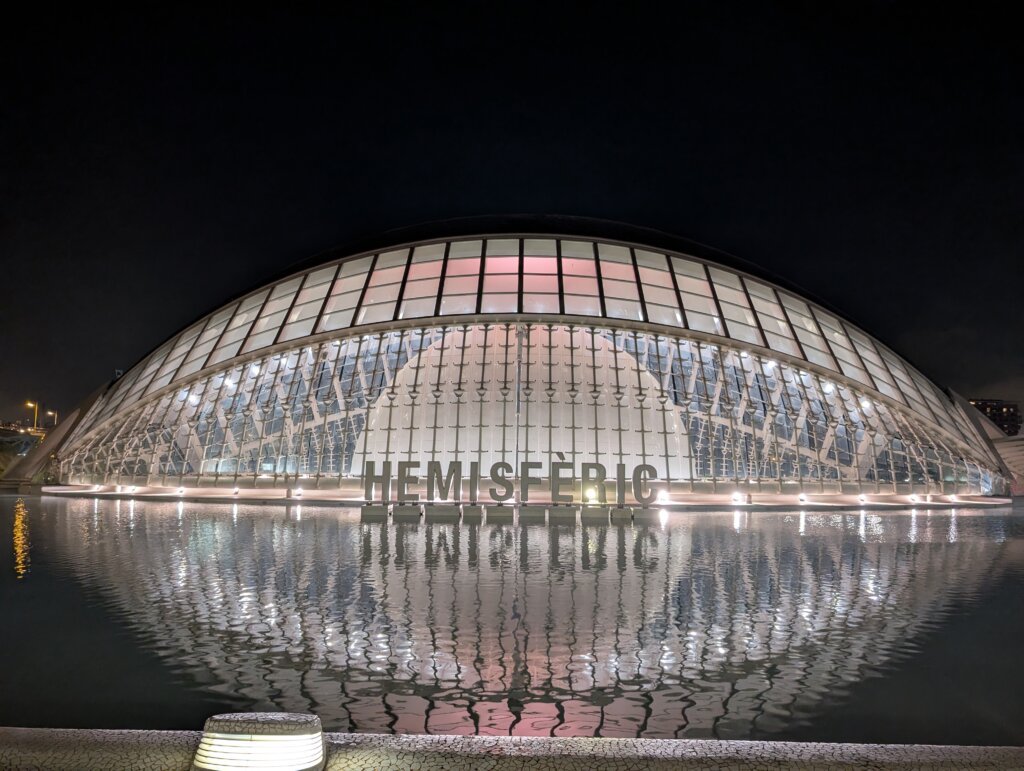
L’Hemisfèric is the eye-shaped IMAX dome and planetarium, and it was the first building in the complex to open.
It represents a human eye, the “ull de la saviesa” or eye of wisdom. It’s on top of a 24,000 square meter reflecting pool that completes the shape.
Admission runs around €9 for one projection.
They play short movies about 45 minutes on a 900 square meter concave screen. The films are the usual nature and space documentaries.
I think this is usually worth skipping. I’d really only spend time going in if you’re coming with kids, if you have lots of time, OR you reaaaallllyyy need to sit down for a while.
In July or August, after three hours of walking around open white concrete in direct sun, forty-five minutes in a dark air-conditioned dome… Well, I won’t judge you for wanting a rest.
Arrive on time, though. They do not let you in once a projection has started, and there is no flexibility on that whatsoever.
Museu de les Ciències Príncipe Felipe
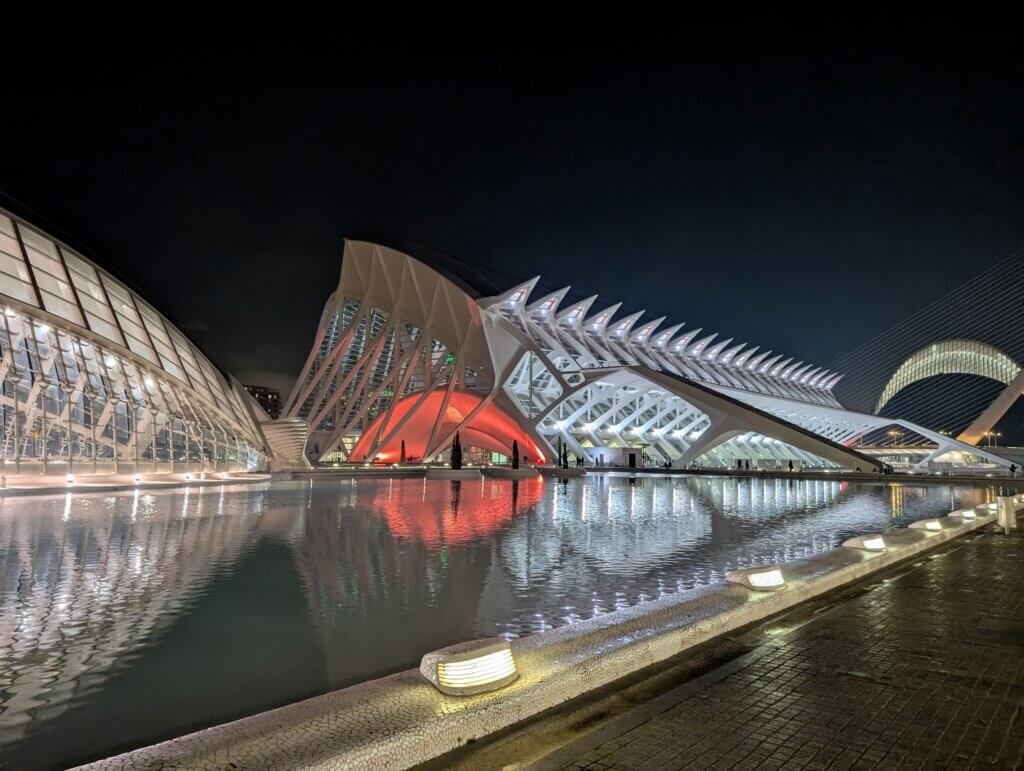
The Museu de les Ciències is an interactive science museum spread over more than 40,000 square meters and three floors.
Its motto is “Prohibit no tocar, no sentir, no pensar”. That means “forbidden not to touch, not to feel, not to think.”
Admission is around €9, and the official visit estimate is two hours. Again, the prices is dynamic so it changes depending on the season.
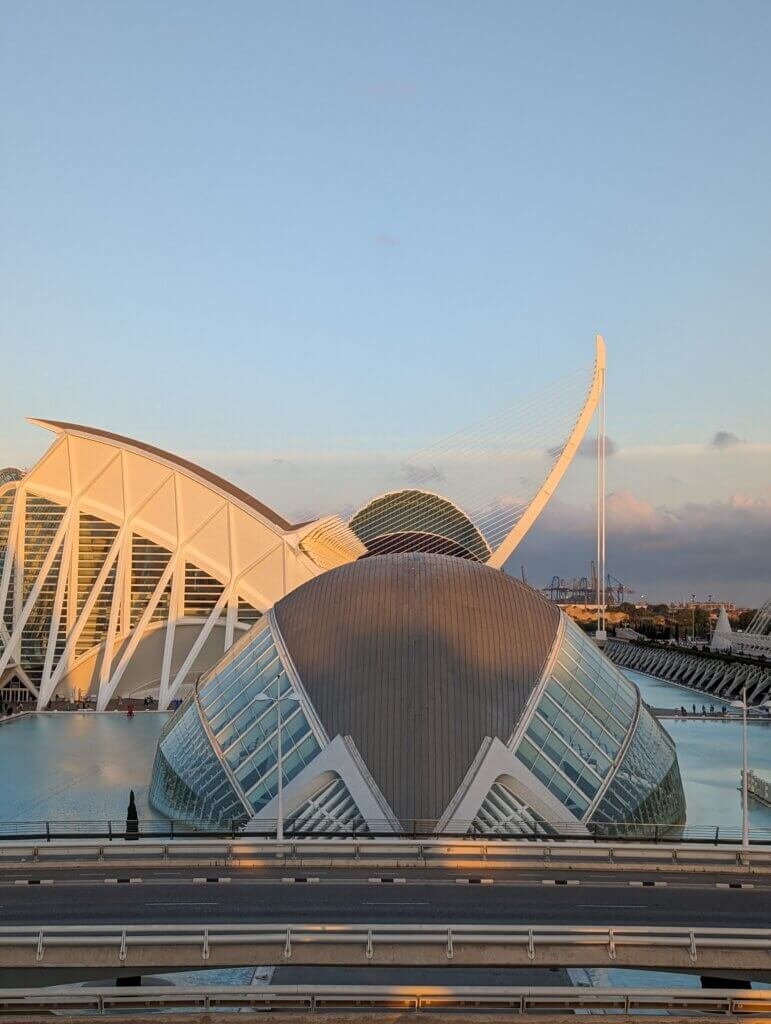
The outside building itself is the part I would not skip. Calatrava designed it to read as the skeleton of a whale, and from a distance the white ribs reflected in the lake is one of my favorite views. Although a lot of visitors photograph it without ever noticing the reflection.
Inside, children love it. Science nerds will have a fantastic time. Adults traveling around Europe looking for culture and monuments… probably will think it’s a waste of time.
If museums are your thing generally, my guide to museums in València covers the rest of the city, several of which I would visit before this one.
L’Oceanogràfic
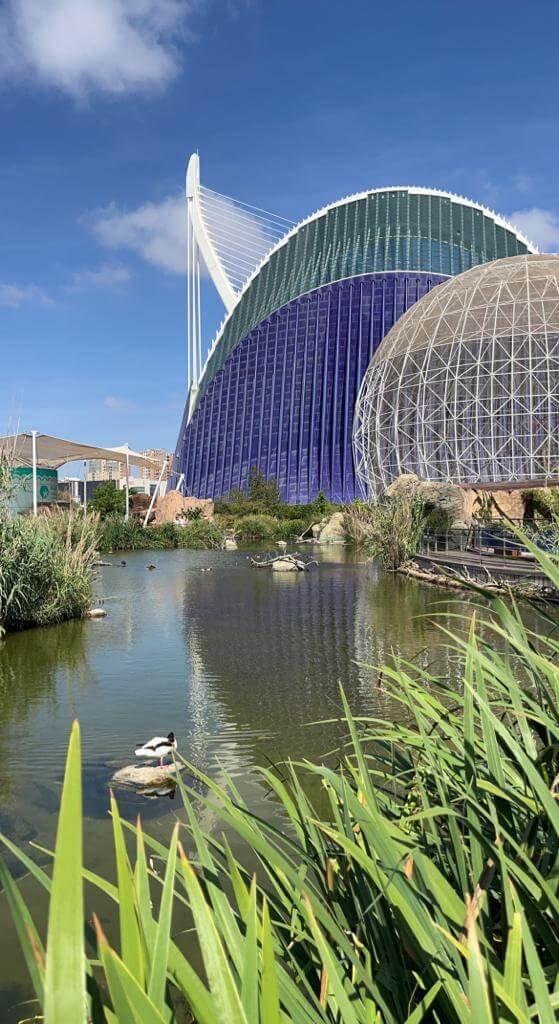
L’Oceanogràfic is the largest aquarium in Europe, holding around 45,000 animals across 500 species, and it opened in 2003.
For most people, it’ll take between 2 and 4 hours. Depending on how much you like to stop, see everything, etc. And obviously if you have kids it’ll take longer.
If you are only going to pay for one thing here, make it this one. I think it’s a really fun experience and they do a lot of really important conservation work here in the Mediterranean.
Highlights include Europe’s only beluga family, a 70-meter shark tunnel, and the dolphin exhibitions.
I have written a full guide to whether the Oceanogràfic is worth it that covers the pricing tiers, the best times to arrive and which of the paid extras are worth adding.
It usually costs around €40 (again, dynamic pricing). I do recommend getting a ticket ahead of time, as sometimes they sell out in the busy season.
L’Umbracle
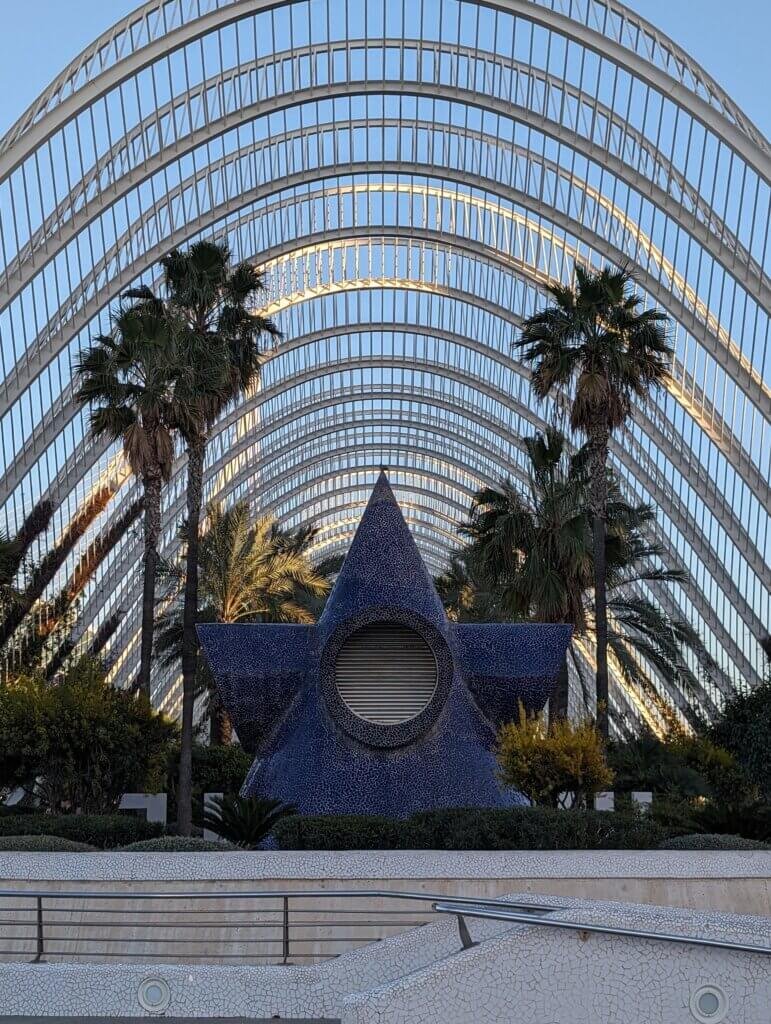
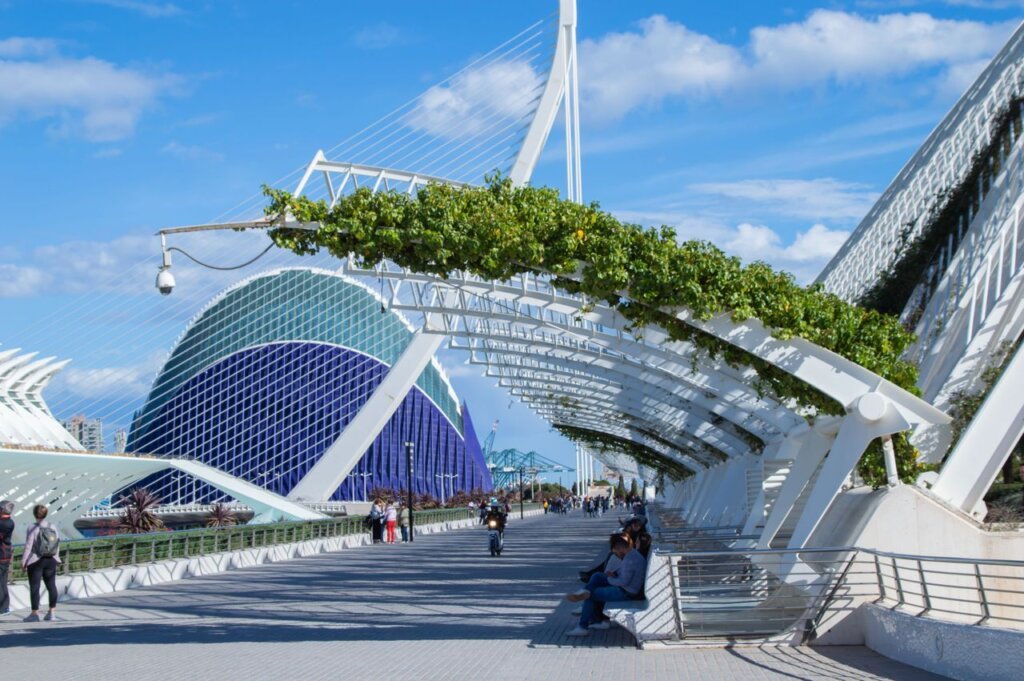
L’Umbracle is a covered promenade of arches and Mediterranean planting that runs along the eastern edge of the complex, and it is free during the day. It opened in 2001 and was supposed to be the entrance to the whole site.
The plants are all native to the area. Rosemary, thyme, bougainvillea and palms, all species you would find growing around València. There is a sculpture walk along its length and a small astronomy garden.
It also offers tons of shade, which is lovely. Although the original idea was to have the vines cover the ENTIRE complex…but they plants just aren’t growing like they wanted.
At night in summer the Umbracle turns into an open-air club, which is a completely different vibe and covered in my Valencia nightlife guide.
Palau de les Arts Reina Sofia
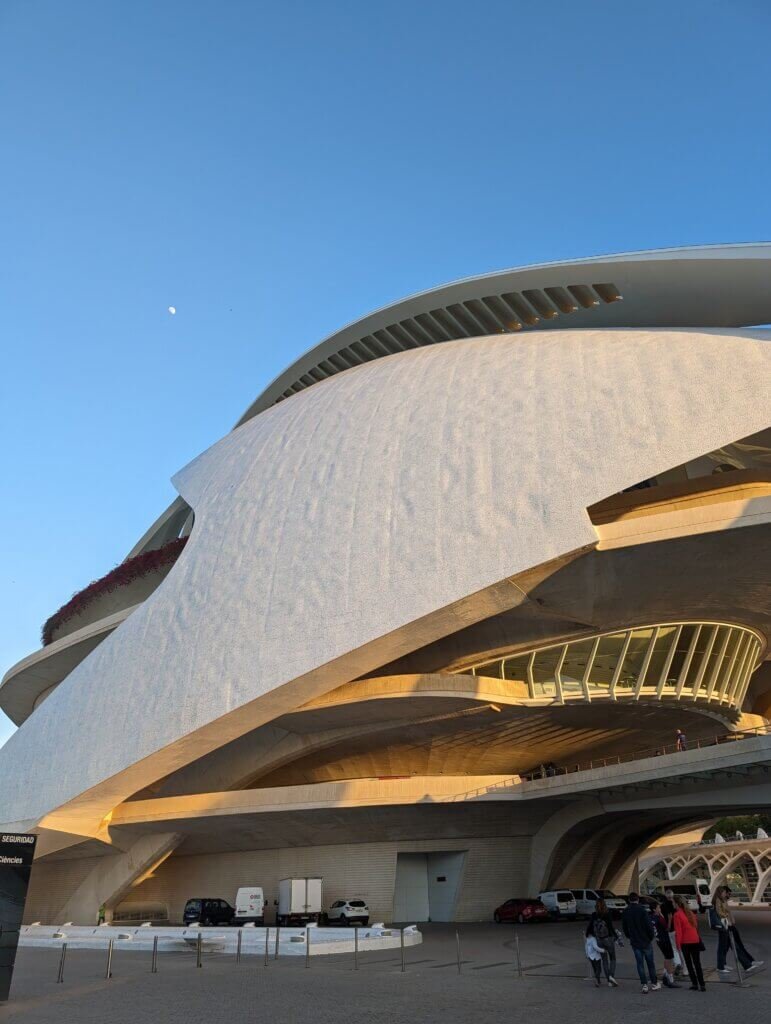
The Palau de les Arts is the opera house, opened in 2005, and at 75 meters it is among the tallest opera houses in the world.
It’s exterior is supposed to represent marine life symbols. Some people say it looks like a shell, and others say it looks like a ship coming out of the water.
If you are here during the season and want to see inside, check the program in advance rather than just hoping for tickets. They often sell out.
L’Àgora, Now CaixaForum València
L’Àgora is the deep blue building at the southern end, opened in 2009, and it now houses CaixaForum València, a cultural center with rotating art and science exhibitions.
General admission is €6, it opens daily from 10:00 to 20:00, and entry is free for under-16s and CaixaBank customers.
This is mostly used as an auditorium or events space. So I really do NOT recommend visiting it.
But again, I wouldn’t really bother visiting it personally.
The Bridges
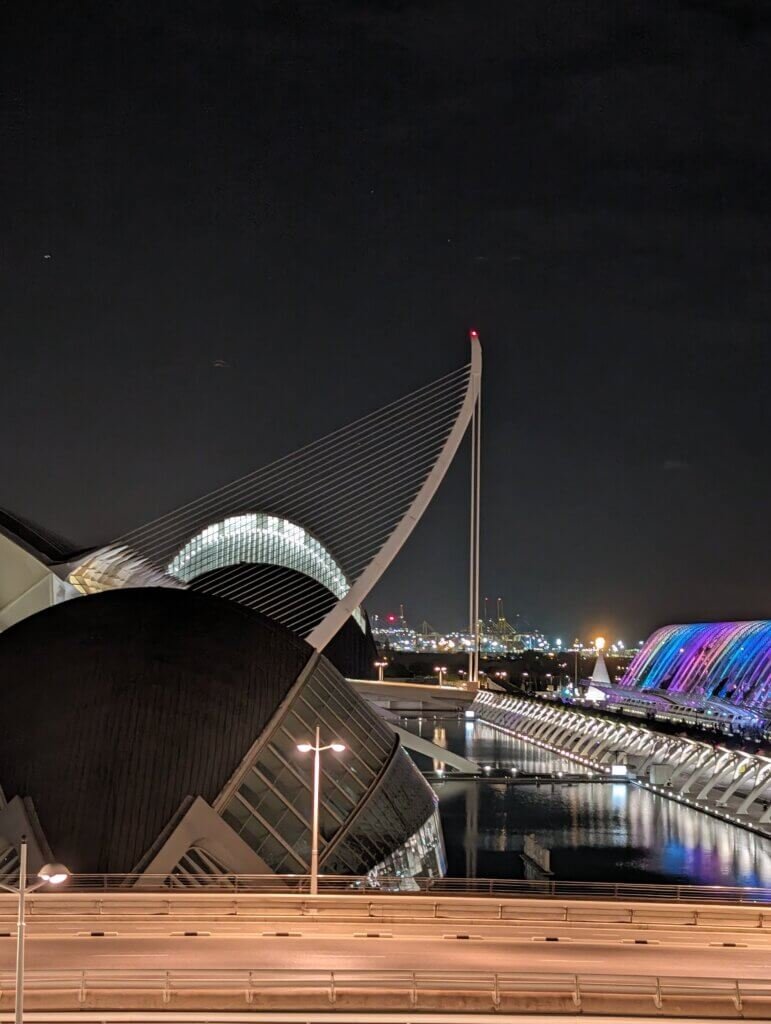
Two bridges cross the complex and both are public, so you walk across them for nothing. The Pont de Montolivet opened in 2007 and the Pont de l’Assut de l’Or in 2008.
The Assut de l’Or is the cooler one. It has a single white mast rising 125 meters with the cables fanning down from it. Which makes it the tallest structure in the city, and the name refers to a medieval weir that once diverted water from the Túria into the irrigation channels.
I don’t think you really need to cross the bridges. But definitely get a good look at them while you’re vising the other buildings.
The Trencadís, and Why Everything Is White
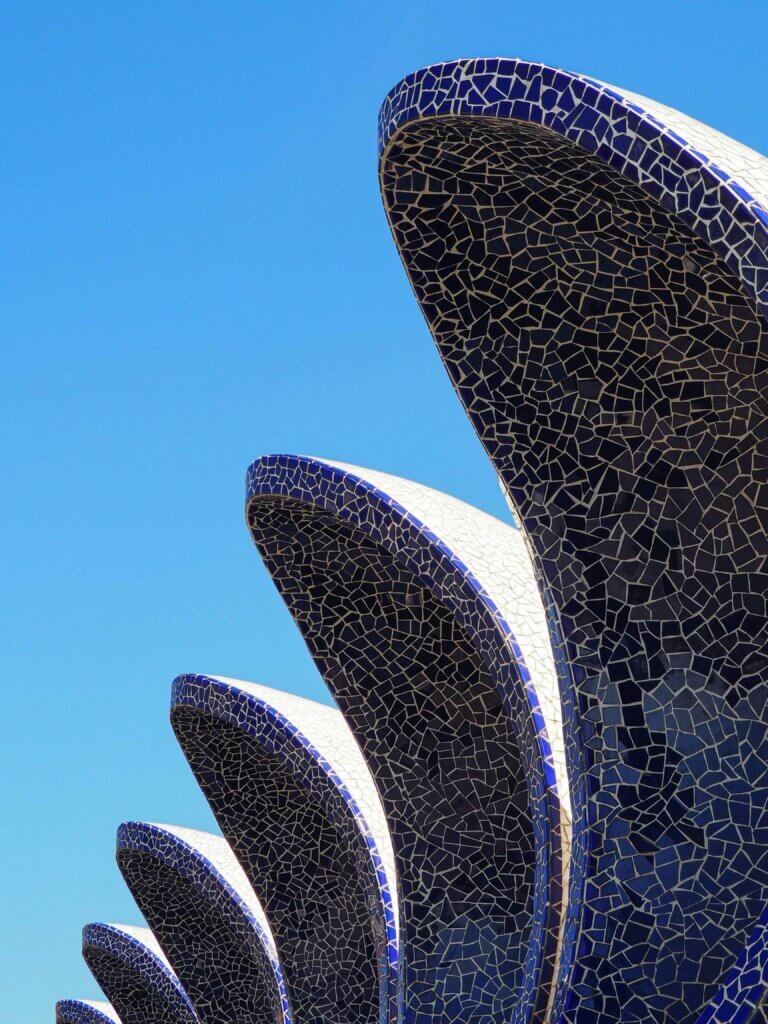
The buildings are clad in trencadís. This is a mosaic technique made from broken ceramic tile fragments that is traditional to València. Plus, you might recognize themfrom Gaudí’s work in Barcelona.
Calatrava used white trencadís across most of the complex and cobalt blue on the Umbracle and the Àgora, over a structural base of white concrete.
This is the detail I want people to understand, as it’s the primary way that the designs mix the cultural & historical with these very modern buildings.
You’ll also find it in the Estació del Nord and on the Mercat de Colom, both of which predate this complex by roughly a century. So the newest architecture in València is giving a nod to the modernisme valencià.
The Best Photo Spots
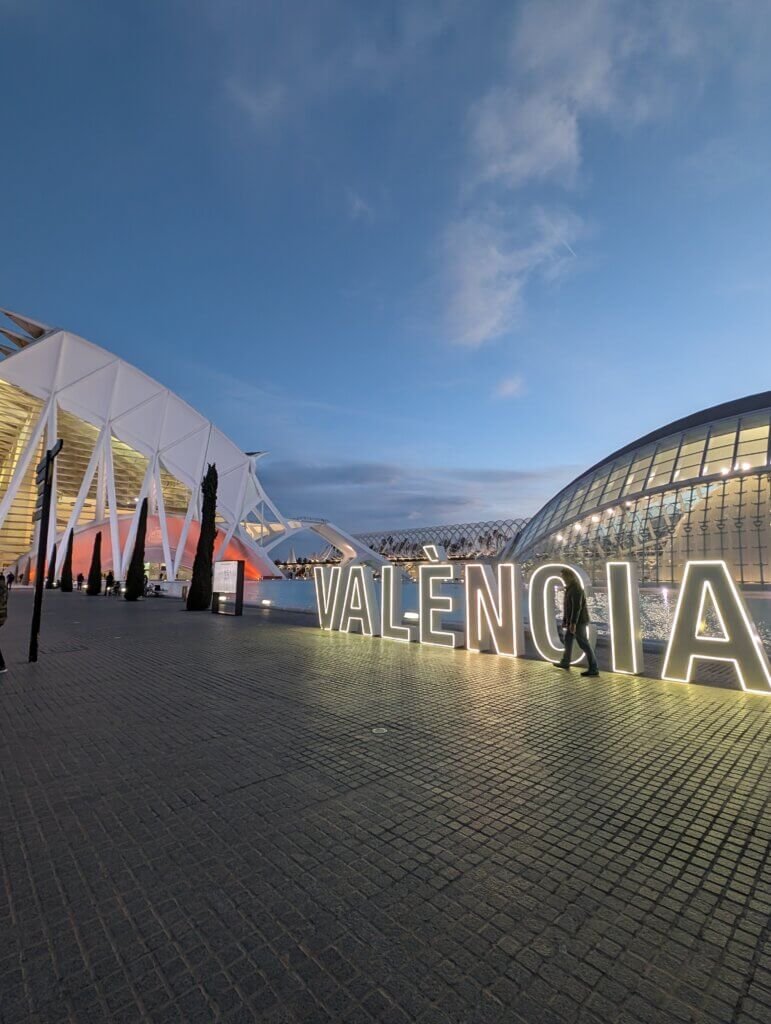
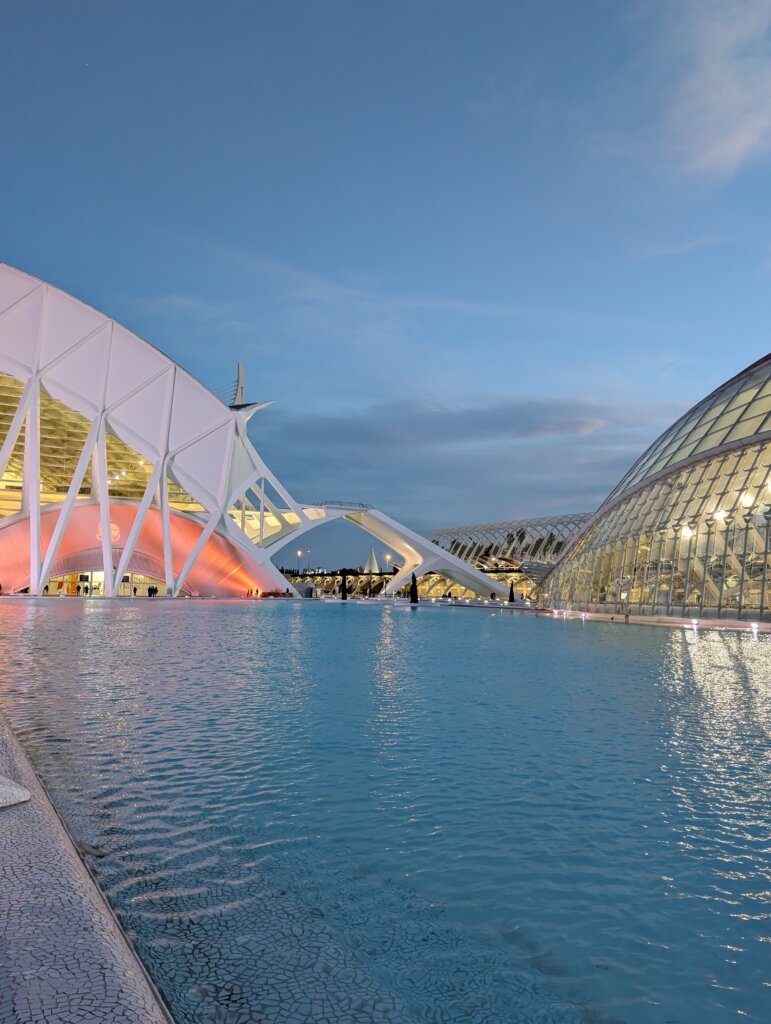
The single best shot on the site is L’Hemisfèric reflected in its pool, taken low and straight on from the western edge, because the reflection completes the eye. The building alone is a half-shape. With the water it becomes an eye with a lid, a lash and a pupil, which is what Calatrava designed and what most visitors photograph without quite achieving.
For the Museu de les Ciències, back off rather than moving closer. The whale-skeleton ribs only read as a skeleton from a distance, ideally from the Pont de Montolivet or the far side of the lake, and the late afternoon sun hits that facade directly.
The Umbracle walkway gives you the repeating-arch shot that everyone recognizes, and it is also raised, so it works as a vantage point over the rest of the site.
On timing, sunrise is the underrated slot. The light is soft, the pools are still, and you will have the place to yourself in a way that simply does not happen at sunset. Blue hour just after sunset is the other strong option, since the buildings are lit and the pools hold the color.
I include the complex in my roundup of the best sunset spots in València, and it appears in my Valencia landmarks guide alongside the older architecture worth photographing.
Visit in the evening
Yes, and for a lot of visitors the evening is the whole visit. The buildings are lit after dark, the reflecting pools hold the light, and in summer it is the only time of day the site is comfortable to walk around.
So while the paid buildings close in the evening, I think it’s worth seeing them with all the lights on.
The Umbracle keeps going later than everything else in summer, when it operates as a club. And if you want another reason to be here after dark, the Palau de les Arts program is the obvious one.
If you’re here on a short trip and don’t want to visit the insides of any of the buildings, then I think the evening is the best time to visit the Ciutat de les Arts i les Ciències.
Which Single Building Should You Pick?
The Oceanogràfic, almost every time.
It’s one of the few paid experiences in Valencia that I usually think is worth it. Although it is an activity that’ll take up an entire morning.
And if you are here for the architecture rather than the contents, pick none of them.
Walk the site, cross the bridges, get low at the Hemisfèric pool, and put the €51.25 toward a rice lunch and a night out instead.
What It Cost, and Why Some Valencians Resent It
The City of Arts and Sciences is definitely controversial. While the complex is now a symbol of the city…a lot of locals are still upset about it.
The project was originally budgeted at around €300 million in 1991 for three structures. More buildings were added, costs climbed, and the final figure came in at roughly €1.2 billion, around four times the original estimate.
The Palau de les Arts is where the problems concentrated. It opened in 2005 at a cost of about €478 million, and within eight years it had suffered a collapsed stage platform, flooding in its lower levels, and then, in December 2013, pieces of trencadís falling off the facade in high winds.
Inspections found that roughly 60 percent of the roof cladding had come loose, which meant removing all of it.
Then the government (La Generalitat) went on to sue Calatrava’s office and the construction companies involved, and for several years the opera house sat there stripped back to bare grey metal.
And theeeeen, count all the corruption cases, misuse of funds, and the fact that for the first 26 years, it was in the red consistently.
So, when a Valencian tells you the buildings are a monument to public money rather than to architecture, they are not being cynical for the sake of it.
While none of that should stop you visiting. I do think it’s important to understand how tourism, politics, and city infrastructure are all connected. And it’s a good connection to my posts on what not to do in València and in my tourist traps guide.
The Free Version
Traveling on a budget? Here’s what you should do for free.
Walk or cycle down through the Jardins del Túria from the old town, arriving in the late afternoon. Circle the buildings from the outside, cross the Pont de l’Assut de l’Or, and walk the full length of the Umbracle for the shade and the arches.
Then find the western edge of the Hemisfèric pool and wait for the light to drop. That is when the reflections do their work and when the photographs everyone recognizes actually get taken.
It’s super pretty and costs nothing at all.
More ideas along these lines are in my post on free things to do in València, and the complex also features in my top things to see in València roundup.
Planning Your Trip to Valencia?
Want some help visiting Valencia?
I offer a bunch of travel services to help you:
And if you want regular updates, hidden spots, and seasonal recommendations delivered straight to your inbox? Sign up for the Abroad in Valencia newsletter. I write it myself and it is always free.
Bon viatge,
I hope this helps you get a better idea of the Ciutat de les Arts i les Ciències. It’s a really cool complex (even if it has a controversial history). But for the average visitor, I think you’ll have a great time.
Any questions, concerns, or want to learn more – just send me a message 🙂
Need help planning your trip to Valencia?
Here are the tools I use for the cheapest (and most reliable) vacation planning:
- 🏠Booking – Affordable hotels and apartments
- 🏠Hostel World – Safe and budget-friendly hostels
- ✈ Kiwi – My favorite tool for cheap flights
- 🚗Discover Cars – Best place for car rentals
- 📶Airalo – eSim cards for easy internet access while traveling
- 🦺Safety Wing – The #1 travel medical insurance
- 💸Airhelp – Cancelled flight compensation (it’s free!)
- 🗂️ Your Spanish Visa – Move to Spain the easy way
- 🍊 My Tourist Card Calculator – Find out if the VLC travel card is worth it for you
Affiliate disclosure: This post may contain affiliate links. These are links to services I personally recommend using for your trip to Valencia. At no extra cost to you, I may earn a small commission from these brands if you choose to make a purchase. Your support helps me pay my bills and eat more bunyols!
FAQs
Mostly, yes. Walking the site, photographing the buildings, crossing both bridges, walking the Umbracle and circling the Hemisfèric’s perimeter ring all cost nothing. Only the Oceanogràfic, Museu de les Ciències, Hemisfèric and CaixaForum charge admission, and for a lot of visitors the free version is the whole experience.
For the exteriors alone, about 90 minutes, ideally timed for late afternoon. Add four hours for the Oceanogràfic, two for the Museu de les Ciències and 45 minutes for a Hemisfèric projection. Doing all three properly is a six to seven hour day, which is why the ticket is valid across up to three consecutive days.
Only for performances or occasional guided tours, so it is exterior-only for most visitors.
It is genuinely at its best around dusk and just after, when the buildings are lit and the reflecting pools do their job. In summer this also means avoiding the worst of the heat on a site with almost no shade. The paid buildings close in the evening, so a night visit is an exterior visit, which suits most people fine.