
When I moved to Valencia back in 2018, getting my empadronament was one of the very first things on my list. And it felt more intimidating than it needed to be. The empadronamiento in Valencia (the Spanish spelling you’ll see everywhere) is free, you can absolutely do it yourself, and once you understand the steps it’s aaactually not that scary. Though the first time is always the trickiest, so this guide walks you through the whole thing the way I wish someone had walked me through it.
I’ve since helped friends, plus my Valencian husband and I have done this dance more than once. So everything here comes from my personal experience and my expertise dealing with Valencian bureaucracy.
Last verified: August 2026. Offices, hours, and rules can change, so double-check the official links before you go. This is also not legal advice, but you can consult a lawyer here.

- What is the empadronament (padró) in Valencia?
- Why do you need to get empadronat in Valencia?
- How to get your empadronament in Valencia, step by step
- Where do you go? Valencia's empadronament offices and hours
- Documents Needed:
- Volant vs. Certificat d’empadronament
- Do you need a NIE to register?
- Can you do the empadronament online in Valencia?
- Renewing the Empadronament
- How much does the empadronament cost?
- Register the whole family (children included)
- Frequently Asked Questions
- Bona sort!
- Need help planning your trip to Valencia?
- Want no-stress travel planning?
What is the empadronament (padró) in Valencia?
The empadronament (or padró in Valencian, padrón in Castilian) is the municipal register of everyone who lives in Valencia. You can kinda think of it like a census.
Registering means going to the Ajuntament and putting on record that you live at a specific address in the city. It’s free AND it’s a legal obligation for anyone living here. Then your proof of it is a document called the volant or certificat d’empadronament.
Think of it as the city’s way of counting who actually lives here. That count feeds local budgets, school places, and health center assignments, so it matters more than a dusty formality suggests.
You’ll also see it called valencia padron or empadronamiento valencia online when you start searching, and they all point to the same thing.
Quick note
You’ll also find the Spanish-language equivalent of a lot of these names. Empadronamiento in Spanish means Empadronament in Valencian.
Since I live in València, where the official language is Valencian, I’ll be using those terms here. But if you have any questions, just send me a message.
Why do you need to get empadronat in Valencia?
You need the empadronament because almost every other step in your bureaucracy journey asks for it first. It unlocks your NIE and TIE appointments, your SIP public health card, enrolling kids in school, exchanging your driver’s license at the DGT, and opening most Spanish bank accounts, applying for citizenship…
So yeah, you can say it’s pretty important lol.
That last point is the one people underestimate. Your registration history is what proves how long you’ve genuinely lived here. So you’ll definitely want that paper trail intact when you apply for residency renewals or citizenship down the road.
On the everyday side, most people get empadronat specifically so they can open a bank account and set up direct debits. And you know, money is important for living, sooo you’ll probably want to do this as soon as you move here.
If you’re at the very start of a move, my full guide to moving to Spain and the cost of living in Valencia are worth a read alongside this one.
Planning a move? Grab my free Spain relocation checklist so you don’t lose track of the empadronament, the NIE, the SIP card, and the dozen other things that pile up in your first month.
How to get your empadronament in Valencia, step by step
Getting your empadronament comes down to five steps:
- Gather your documents
- Book a cita prèvia online,
- Attend your appointment at a municipal office,
- Collect your volant/justificant,
And number 5: set up a digital certificate so you never have to do it in person again. The whole process is free, and the appointment itself usually takes ten to fifteen minutes once you’re at the desk.
Step 1: Gather your documents (and over-prepare)
Before anything else, the first thing you’ll need is your ID and your proof of address, because the office will check both.
My best advice, and the reason my own registration went smoothly, is to be almost annoyingly over-prepared. I brought originals and photocopies of everything, and I’ve never regretted it.
At a minimum, you’ll want your passport or residency card plus a photocopy, and a document proving you live at the address. There’s a full list further down, including what to do if the contract isn’t in your name.
Step 2: Book your cita prèvia online
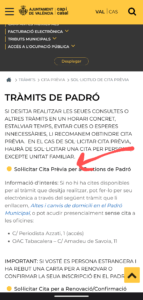
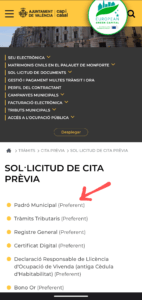
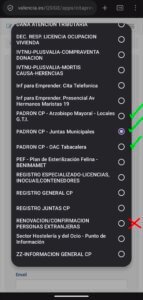
You can’t just walk in, you need a cita prèvia (prior appointment). Book it on the Ajuntament’s official website by searching “padró” or “empadronament”. Choose your district office, and book an open slot.
If the website is fighting you, you can also call 010 from a local line.
Tip: appointment slots can vanish fast, sometimes within an hour of being released. In fact, don’t be surprised if there are no appointments available when you try for the first time (welcome to València 🫠).
If you don’t see anything, check again first thing in the morning when new slots tend to open, or widen your search to a district office a little further out. A slightly less convenient office beats waiting three weeks.
Step 3: Go to your appointment
Important: As of 2026, there are several places you can go to do this. It’s not ONLY at the City Hall anymore. This page shows all the available offices.
Show up a little early with your paperwork. Even if you have an appointment, there’s likely to be a line. You’ll probably be waiting a while.The reason is that when you book a time, you’re actually in a group of people with the same time.
Once you get there, you’ll go to reception and they’ll give you a number. Then you just watch on the screen for them to call your number.
Then you can walk up, say bon dia, and let them know that you want to do the empadronament. Something quick like:
“Bon dia, volia empadronar-me. Ací tinc els documents” (Hi, I wanted to register myself. Here’s my documents).
A few more tips:
First, speak the language if you can. I’ve had friends run into real friction at the desk simply because they couldn’t follow what the person was asking. They’re not required to speak English, soooo…
My own went fine largely because we handled it in Valencian. If your Spanish or Valencian isn’t there yet, bring someone who speaks it, even just a friend. It’s worth starting to learn some Valencian anyway once you’re settling in.
Second, be lightly insistent when you need to be. Sometimes the worker will hesitate on a slightly unusual case and act like it can’t be done. Often it can, you just have to push politely. Americans in particular tend to back off the moment there’s resistance, but here a calm, friendly bit of persistence is completely normal and frequently what gets you registered.
Step 4: Collect your volant or certificat de empadronament
In most cases you’ll walk out the same day with your volant d’empadronament, the printed proof that you’re registered. That single sheet is what you’ll hand over for your NIE, your SIP card, and the rest. Keep a scan of it on your phone, because you’ll be asked for it more than you expect.
If you specifically need the official certificat rather than the volant, make sure you ask for/confirm that. In València, there’s no fee for this.
If you’re unsure, ask for the certificat. Most of the time, I’d prefer to have the actual certificat d’empadronament. It’s more legally-binding.
Step 5: Set up your certificat electrònic for future moves
Here’s the tip I give everyone: the first empadronament is the hard one. Once you’re registered, apply for a certificat electrònic (digital certificate) and set up Cl@ve, and from then on you can handle padrón changes online.
This is a digital certificate that links to your identification card (your TIE). Every time you move afterward, you skip the in-person appointment entirely and do the paperwork from your couch. It’s the single best thing you can do to make Spanish bureaucracy less painful going forward.
Only issue is… you need to have your certificat d’empadronament to apply for your TIE… So the first time you gotta deal with going in person 😅
Where do you go? Valencia’s empadronament offices and hours
Empadronament appointments in Valencia happen at the central Oficina del Padró on Plaça de l’Ajuntament and at six Juntes Municipals de Districte spread across the city.
It used to be only at the City Hall. This has changed as of August 2026.
All of them handle registration, and all keep the same hours: Monday to Friday, 8:30 to 14:00. Booking at a quieter district office is often the fastest way in.
| Office | Area | Hours |
|---|---|---|
| Oficina del Padró (Casa Consistorial) | Plaça de l’Ajuntament, city center | Mon–Fri 8:30–14:00 |
| Junta Municipal d’Abastos | Abastos | Mon–Fri 8:30–14:00 |
| Junta Municipal de Russafa | Russafa | Mon–Fri 8:30–14:00 |
| Junta Municipal del Marítim | Poblats Marítims / El Cabanyal | Mon–Fri 8:30–14:00 |
| Junta Municipal de Patraix | Patraix | Mon–Fri 8:30–14:00 |
| Junta Municipal d’Exposició | Exposició / Blasco Ibáñez | Mon–Fri 8:30–14:00 |
| Junta Municipal de Trànsits | Trànsits | Mon–Fri 8:30–14:00 |
Which one you pick usually comes down to appointment availability rather than proximity, though it helps to register in the district where you actually live. If you’re still figuring out where that is, my Valencia neighborhood guide breaks the districts down.
Documents Needed:
Of course, to handle this process you’ll need a few documents. Luckily, it’s not too complex. You’ll need:
- Your TIE or Passport (or DNI if you’re a citizen)
- Proof of Address
- A receipt of most recent payment if you’re renting
Please note that the documents MUST be in Valencian or Spanish. If the original documents are in English, then you’ll need a traducció jurada (official translation).
For anyone under the age of 18, you’ll also need their birth certificate or “llibre de família”. If their birth certificate was originally from an English-speaking country, you’ll need to get it translated and apostilled (depending on your country of origin).
Please note that these things change, but you can always double-check the website to see exactly what you need. Check here for any updates. This page is relatively lengthy, but shows all the different documents that are accepted. If you have any issues or concerns, I suggest referencing this specific page when you go to present the documents. While only the actual law is legally-binding, this is the City Hall’s official page and they do a good job at keeping it updated.
Also, please make sure that you bring the ORIGINALS and PHOTOCOPIES.
(I’m screaming at you in caps-lock so you know it’s important!)
Proof of Address
You have a few options for documentation.
- Escritura/Nota simple. If you’re the owner of a property.
- Rental Contract. If you’re renting from an agency.
- Autorització. A signed letter from your roommate or other person who is allowing you to stay in the home.
So if you’re renting, you’ll most likely need a signed rental contract (with the owner’s signature as well).
Please note that the contract MUST have:
- The owner’s name
- The exact duration of the contract
- The referència cadastral
And like I said, it needs to be in Valencian or Spanish. If you made the contract in English, it needs to be officially translated.
If you don’t have a contract or you’re staying with someone, the workaround is the autorització. This is called an autorització d’inscripció en vivenda aliena.
It’s basically a signed letter from the person whose name is on the lease or deed saying you live there with their permission. Pair that with their ID and their housing document (their contract or escritura), and you can register on their address.
Volant vs. Certificat d’empadronament
The volant is the everyday proof of registration. It’s usually enough for things like banks, etc. But the certificat (certificado) is the official, legally weightier version.
Both are free!
For things like applying for citizenship or permanent residency, I suggest going for the certificat d’empadronament. Make sure to ask for it when you’re during the process.
Sometimes they don’t want to give you the certificate immediately. This happens when they’re super busy. They often do additional checks (* cough red tape cough*), so they might not give it to you right away.
In that case, just ask for the volant. Then go on this website and submit a request for the certificat d’empadronament. If you have your certificat electrònic, it’ll be automatic. If you don’t yet, then it’ll take about a week.
Do you need a NIE to register?
Technically, you don’t need your NIE yet. This is your ID number which appears on your TIE.
➡️ Read here about how to get your NIE.
But you can apply with just your passport number. Eventually, however, you will want to empadronar-te with your TIE, especially if you’re staying long-term
If you’re still sorting out visas and the NIE side of things, my overview of Spain visa options is a good starting point. And if you’re reaalllyyy getting stressed over all the paperwork, I usually refer people to Your Spanish Visa. That link gets you 10% off if you’d rather hand the bureaucracy to someone else.
Can you do the empadronament online in Valencia?
Partly. If you just moved here, then you’ll need to do it in person.
Your very first registration at a new address usually needs the in-person cita prèvia, since the office has to verify your documents.
However, once you have your certificat d’empadronament and your TIE, you can then apply for the certificat digital. This is an electronic registry that allows you to do official paperwork online.
So the first one is in person. Then anything moving forward can be online.
Renewing the Empadronament
Important: it’s not permanent for everyone!
Non-EU citizens with temporary residency have to renew (confirm) their empadronament every two years under INE rules, or the city can remove you automatically through a process called baixa per caducitat. EU citizens, Spanish nationals, and non-EU permanent residents are exempt and don’t need to renew.
This is suuuuuper important! Because if you’re staying here long term and your registry expires, that can cause issues later on with renewing your actual residency. So keep an eye on that!
How much does the empadronament cost?
The empadronament is free.
Registering costs nothing, the volante costs nothing and neither does the certificat.
I mean, you may pay with your mental health trying to figure out bureaucracy in a new country… but you’ll pay zero euros!
I genuinely don’t think this process is that complicated. As long as you double-check which documents you need and then make sure you bring originals and copies, you should be fine.
That said, if your move is super complicated, then I do usually suggest checking out Your Spanish Visa. They’re a lawyer team I partner with.
And I also have a free relocation guide that may help.
Register the whole family (children included)
Yes, everyone living at the address registers, including children.
You can usually do the whole family in one appointment as a unitat familiar, which saves you booking separate slots. For kids, you’ll need their birth certificate or the llibre de família, and for non-EU families those documents may need an apostille.
If you’re registering minors, bring proof of your relationship to them and, where custody is shared or complicated, any relevant custody or consent paperwork. The worker needs to see that the adult registering the child has the standing to do it, of course.
Frequently Asked Questions
If appointments are available, you can often be registered within a week or two, and the appointment itself takes about ten to fifteen minutes. Although on busy days, you may wait up to 30 minutes first. The real variable is cita previa availability, which in València can be complicated.
It’s difficult. The Ajuntament wants proof of habitual residence, and short-term tourist contracts usually don’t qualify. If you’re in a temporary place, your best route is an autorització from a friend or landlord whose name is on a real contract, or waiting until you have a longer lease.
Yes. Everyone who lives habitually in Spain is legally required to register in their municipality. Beyond the legal obligation, you’ll need it constantly for other paperwork, so there’s no real upside to skipping it.
Not for your first registration at a new address, which normally needs an in-person appointment. After that, with a certificat electrònic you can handle everything online. But you need the first empadronament to get this digital certificate.
Check the site early in the morning when new slots are often released and check all the offices, not just the city hall.
If you move within Spain, you register at your new municipality and that generally handles it. If you leave Spain entirely, you can request a baixa, and non-EU temporary residents are removed automatically if they don’t renew every two years.
Bona sort!
That’s the whole empadronament in Valencia, start to finish. What the padró is, why you need it, the documents to bring, how to book the cita previa, which offices to use, the volante versus certificat question, and how to get your registration for free without paying anyone…
So hopefully this was helpful!
Do this one carefully and the rest of your Spanish paperwork gets a lot easier.
If you’re moving to Valencia and want a hand with the bigger picture, download my free Spain relocation checklist.
In the meantime, getting a handle on Valencia’s public transport and where to find your nearest grocery stores will make your first month a lot smoother.
And if you’ve got a question I didn’t cover, just reach out 🙂
Fins ara! — Kevin
Need help planning your trip to Valencia?
Here are the tools I use for the cheapest (and most reliable) vacation planning:
- 🏠Booking – Affordable hotels and apartments
- 🏠Hostel World – Safe and budget-friendly hostels
- ✈ Kiwi – My favorite tool for cheap flights
- 🚗Discover Cars – Best place for car rentals
- 📶Airalo – eSim cards for easy internet access while traveling
- 🦺Safety Wing – The #1 travel medical insurance
- 💸Airhelp – Cancelled flight compensation (it’s free!)
- 🗂️ Your Spanish Visa – Move to Spain the easy way
- 🍊 My Tourist Card Calculator – Find out if the VLC travel card is worth it for you
Affiliate disclosure: This post may contain affiliate links. These are links to services I personally recommend using for your trip to Valencia. At no extra cost to you, I may earn a small commission from these brands if you choose to make a purchase. Your support helps me pay my bills and eat more bunyols!